
Slavery didn't end.

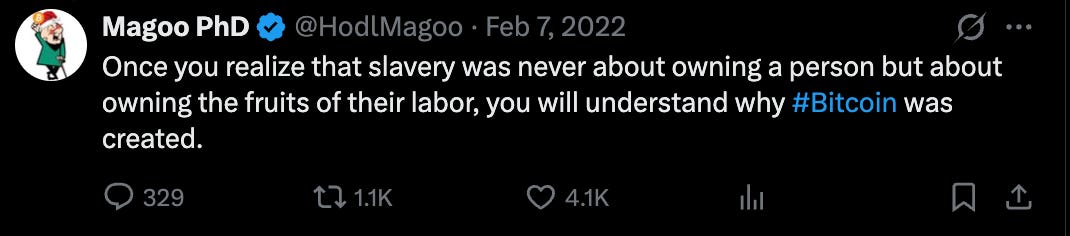
When we think of slavery, we imagine chains. But there is a more insidious form of slavery that is legal, invisible and affects billions of people today.
True slavery isn’t about owning bodies. It’s about controlling the economic output of people’s work.
Throughout history, systems that allow a few entities to claim most of the value you create through your labor have been a persistent form of control.
You trade your time for money. Over a 40-year career, that’s roughly 80,000 hours of your one finite life.
You’re promised that paycheck represents real value. You’re told that if you are careful and save you will be able to enjoy the fruits of your labour at a later date.
But what happens to that money while you sleep?
The Invisible Theft
The government issues debt. The central bank buys that debt with money it has created out of nothing. This increases the money supply. More money chasing the same amount of goods means prices rise. Your existing money buys less.
This happens every year, compounding. Your purchasing power shrinks.
Here is what the debasement of the U.S. dollar looks like over time:
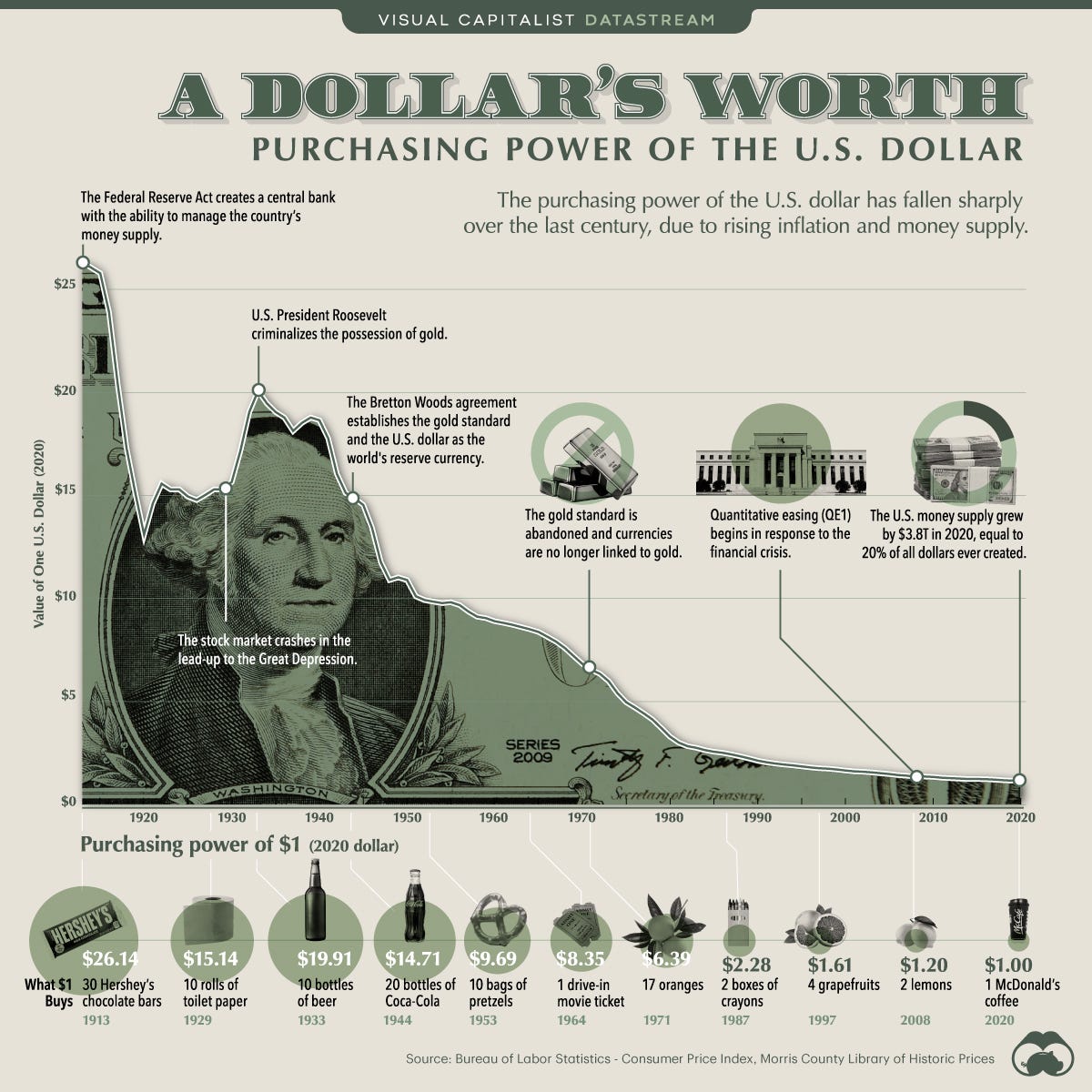
The system is designed this way. Those who get the new money first (banks, governments, the wealthy) benefit because they can buy real assets before the inflationary effect (currency debasement) hits the rest of the economy. Everyone else pays the cost through higher prices at the gas pump, the grocery store, the housing market etc. This is called the “Cantillion Effect”, which you can learn more about here:
The Lifetime Impact
Over a 40-year career from 1986 to 2026, earning $60,000 annually and saving $10,000 per year, you accumulate $400,000 in nominal dollars. But due to inflation compounding over those four decades, that $400,000 would have the purchasing power of roughly $229,000 in 2026 dollars. You've worked 80,000 hours and been disciplined about saving. Approximately $171,000 of your savings, 42% of what you accumulated, has been eroded by inflation alone.
This is why Bitcoin was created.
What is Bitcoin?
In October 2008, as the global financial crisis unfolded and banks collapsed, someone (or a group of people) using the pseudonym Satoshi Nakamoto released a white paper titled “Bitcoin: A Peer-to-Peer Electronic Cash System.” Three months later, on January 3rd, 2009, the first Bitcoin was mined. The Genesis Block. A new form of money launched into a world reeling from the failure of the old one.
Bitcoin doesn’t require a bank, a government, or a company to exist. The code runs on thousands of computers worldwide that verify and secure the system. No single entity controls it. No authority can shut it down.
Satoshi built something with a hard limit. Only 21 million Bitcoins will ever exist. This makes it fundamentally different from the money you use now. Central banks can print dollars endlessly. They did exactly that during the 2008 crisis. But Bitcoin’s supply is fixed by code, not by the decisions of people in power.
How the Game Changed
If you control your private keys, you control your coins. No one can inflate them away, freeze them or seize them without your permission. In fact, you can store your private keys in your head by memorising your seed phrase.
Bitcoin is permissionless. Anyone with internet connection can send or receive value globally without intermediaries.

Proof of Work mining secures the network using real-world energy. Work turns into verifiable, unforgeable transactions.
Over time, holding Bitcoin lets you store the value of your past labor in a form that resists debasement. The value created by those hours of work is yours to keep.
Sovereignty
Bitcoin is economic sovereignty. For the first time in history you can own the fruits of your labor completely. Not as a paper promise, but as a scarce asset that no government or central bank can debase.
What now?
Study bitcoin and learn how to buy bitcoin and store it safely.
You are welcome 🧡