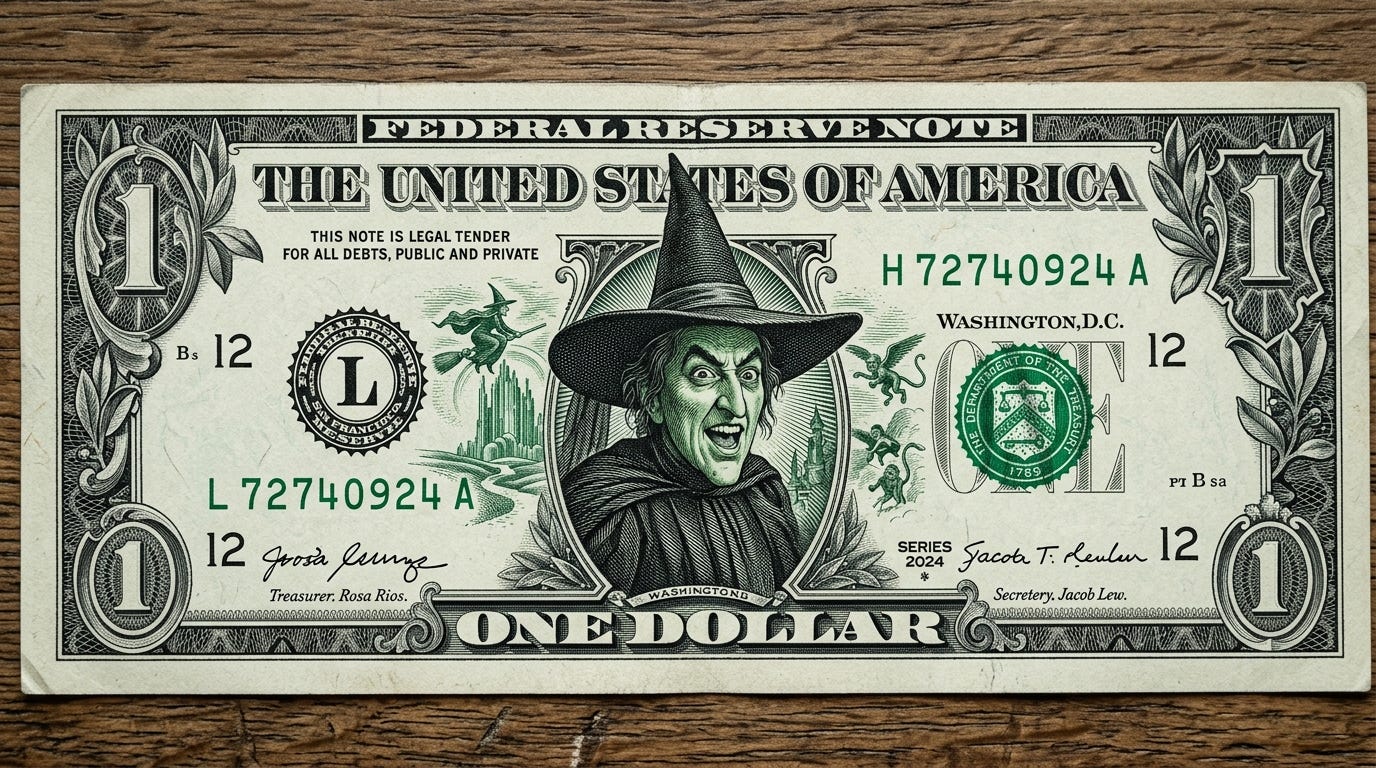
The Man Behind the Curtain
What I Missed at the Bitcoin Conference
I recently spent a few days in Las Vegas for the 2026 Bitcoin Conference. Thousands of us were gathered at the event, orange-pilled, laser-eyed, diligently stacking sats and united by the conviction that the current monetary system is a fraud and that Bitcoin is the exit ramp. We talked about fiat debasement, central bank manipulation, and the slow theft of purchasing power. “We’re so awake…” I said to myself. “How wonderful to spend time with a group of people existing in reality, awake to the widespread fraud and working diligently to opt themselves and their families out of it.”
What could I possibly be missing?
The Sphere
During the conference week I went to the Las Vegas Sphere to catch their current show ‘The Wizard of Oz’, a remastered version of the original 1939 movie with Judy Garland.
The Sphere is a colossal 366-foot globe rising up next to The Venetian, its exterior displaying full-motion visuals visible from across the Strip.
The interior display wraps 160,000 square feet around, above and over the audience in 16K resolution. The audio system has 167,000 individually programmable speakers. The original score was re-recorded with an 80-piece orchestra on the same scoring stage where it was first recorded in 1939. Haptic seats that vibrate with every crash of thunder, wind arrays that push actual air across the auditorium, fog machines and pyrotechnics.
When the tornado hits, you are inside it. When the snow falls over the poppy fields, it falls on you. When Dorothy steps out of her black-and-white farmhouse into Technicolor Oz, the entire 160,000-square-foot screen erupts into colour. It is, without question, one of the most spectacular things you will ever see, and it will ruin regular cinema for you, forever.
The show was incredible. The movie? I have seen it a dozen times. Cute, but meh…
Owen Benjamin and The Man Behind the Curtain
Fast-forward three weeks, I’m listening to the comedian Owen Benjamin being interviewed by Tucker Carlson, a great podcast recording btw, but I digress… Over the course of their two-hour conversation, they start talking about spells, spelling, speech. Owen comments that much of what we are fed is “perception management”.
We’re following the yellow brick road to the Emerald City to see the Wizard of Oz. The mighty Wizard of Oz, who in the end is nothing but an old man hiding behind a curtain pulling levers to create an illusion. Owen then states:
“this is how they do it. It’s all perception management like Wizard of Oz. Wizard of Oz was such a truth drop. It’s all it’s all about… I think it’s about the dollar.”
🎙️Mic drop.
Follow the Yellow Brick Road
Owen goes on:
“Follow the yellow brick road to the green place where the wizard is lying. It’s gold, a golden road, right? It’s like the original slippers were silver. You click the silver slippers and you go back to Kansas. Meanwhile, the greenback is like it’s really just an old grabbler behind a little curtain.
And then he’s like, ‘Here, you’re smart. Here’s a square for your head.’ And it shows you how they do it. It’s all the approval. Like, you’re brave. Here’s a medal. That world of these little trinkets that make you think you’re proud or you’re brave, ‘Oh, now I’m brave.’ It’s like: no. It was such a truther movie.
And then it inflates the balloon, inflation takes him away and he’s like, ‘I don’t know how it works.’ And he flies off.
How does it work?”
I had just been to a Bitcoin conference. I had sat through hours of discussion about how central banks debase currencies, how fiat money is backed by nothing, how the people in charge are operating behind curtains while distributing worthless paper tokens and calling it wealth. Then I had gone and watched The Wizard of Oz in the most immersive format ever created and completely missed the fact that I was watching a film about…exactly that.
After listening to the podcast, I started researching this idea and discovered that Owen was in fact referencing an essay written in 1964 by schoolteacher Henry Littlefield. In the essay Littlefield argues that L. Frank Baum’s 1900 book was a deliberate parable about the great monetary debates of the late 19th century. I should note that much of the book has been edited out of the Hollywood version, so I would encourage people to read Littlefield’s full essay HERE for a full analysis of the various references. Even better, if you have time, go and read the original book.
In 1990, economist Hugh Rockoff at Rutgers published a formal academic paper titled “The Wizard of Oz as a Monetary Allegory” in the Journal of Political Economy, expanding the interpretation with considerable rigour.
Once you see it, you can’t unsee it.
The Yellow Brick Road is the gold standard. The path that the financial establishment insisted everyone follow, the road that led, supposedly, to prosperity. Follow gold. Follow the rules. Follow the road.
The Emerald City is Washington D.C., or more precisely, the illusion of wealth and power that paper money creates. Emerald means green. Greenbacks. When Dorothy and her friends arrive at the Emerald City, they’re given green-tinted glasses and told that everything is emerald. It’s not. The colour is a trick. The city is a stage set for a lie.
The Wizard himself is the man behind the curtain. The fraud at the centre of the system. He terrifies people with a booming voice and a projected image of power, but when the curtain is pulled back, he’s just an ordinary man with a machine. He has no real power. He has only the power you give him. Sound familiar?
The medals, the diploma, the heart - The Wizard’s “gifts” to the Lion, the Scarecrow, and the Tin Man are pure fiat. They confer nothing. The Lion already had courage. The Scarecrow already had intelligence. The Tin Man already had a heart. The Wizard just hands out tokens and tells them they now officially have what they already possessed. He creates value from nothing. He prints the certificate and calls it real.
The balloon and inflation - When the game is up, the Wizard escapes in his hot air balloon. He inflates it, floats away, and calls back saying that he has no idea how it works. The money printer goes brrr. The central banker takes his retirement. The system continues, unaccountable, and the ordinary people are left standing in the field watching him go.
Dorothy herself is the common person, the ordinary American, bewildered by forces she didn’t create and can’t fully understand, just trying to get home to something real.
You can watch an animated “Ted-Ed” on the topic below:
The Slippers Were Silver
The important part of the story, rewritten in the Hollywood version, regards the slippers. In the 1939 MGM film, Dorothy’s slippers are ruby red. They’re one of the most iconic images in cinema history. But in L. Frank Baum’s original 1900 book, The Wonderful Wizard of Oz, the slippers are silver.
MGM changed them to ruby red to take advantage of the new Technicolor film process. Red simply showed up better on screen. However, in doing so they quietly erased the entire monetary subtext from the most-watched version of the story.
In the book’s monetary context, silver is everything. The great political battle of the late 19th century was between the gold standard backed by banks, eastern financiers, and industrial interests, and the movement for silver coinage, championed by farmers, debtors and working people who were being crushed by the tight money supply that gold imposed.
In Rockoff’s 1990 essay he states:
“Between 1869 and 1879 the stock of money grew at about 2.6 percent per year and real output at about 5.0 percent per year, so the deflationary pressure from the lack of monetary growth is easy to understand.”
The Cowardly Lion is widely interpreted as William Jennings Bryan, the populist politician who ran three times for president on a pro-silver platform and famously declared: “You shall not crucify mankind upon a cross of gold.”
In Baum’s story, Dorothy’s silver slippers are the answer. They were on her feet the whole time. She never needed the yellow brick road. She never needed the Wizard. She just needed to click the silver slippers together three times and say “there’s no place like home” and she could return to something real, something grounded, something not built on illusion.
The silver was the solution. The gold road was a distraction. The Emerald City was a lie. And the answer had been on her feet since the beginning.
But Wait! Wasn’t Silver Inflationary?
This is where it gets genuinely interesting, and where I had to pause and think more carefully. At first glance, it seems contradictory: the pro-silver movement wanted to expand the money supply. Isn’t that exactly what we’re all here to oppose?
The answer requires understanding what was actually happening to ordinary Americans in the 1880s and 1890s and it’s not what the term “Gilded Age” might suggest.
The Gilded Age gets its name from Mark Twain, who used it as a deliberate critique: gilded, as in a thin layer of gold over base metal. It looked prosperous on the surface. For the Carnegies, Rockefellers, Vanderbilts, and Morgans, it absolutely was. Industrial fortunes were being built at a staggering rate. But for the vast majority of Americans, farmers, miners, factory workers, it was something closer to a prolonged economic catastrophe.
To understand how that happened, you need to know what came just before it. The period from roughly 1837 to 1863 is known as the Free Banking Era, and it was genuinely chaotic. Individual states chartered their own banks and those banks issued their own paper currencies, theoretically redeemable in gold or silver but frequently not in practice. Some of these “wildcat” institutions were legitimate. Others were essentially fraudulent operations, set up in deliberately remote locations to make it as difficult as possible for anyone to actually claim the gold they were owed. Counterfeiting was rampant. Bank runs were common. The whole system was a mess.
The legislative response was an overcorrection. The National Banking Acts of 1863 and 1864, passed during the Civil War, brought uniformity by creating federally chartered banks with standardised reserve requirements and effectively taxed state bank notes out of existence, collapsing the money supply in the process. Then in 1873, the Coinage Act demonetised silver entirely, placing the United States on a pure gold standard. Silverites later called this “the Crime of 1873.” The pendulum had swung from too much loosely backed paper money to a rigidly constrained hard money system, and ordinary people paid for the transition.
Here’s the mechanism. Gold is excellent money. But the problem in the 1880s and 1890s was that the economy was growing rapidly. More people, more farms, more goods. Meanwhile the gold supply was essentially fixed. You cannot mine gold faster than geology allows. So you had a growing economy with a shrinking money supply relative to the activity happening in it. The inevitable result was deflation: prices falling, year after year.
For a banker in the gold standard era, deflation was wonderful. You lend someone $1,000 today and they repay you $1,000 five years from now but those dollars are now worth significantly more in real terms. You profit without doing anything. Your loan becomes more valuable just by sitting there. Under a hard gold standard with limited fractional reserve banking, the banks were primarily in the creditor seat. Deflation was their friend.
For a Kansas farmer, deflation was a death sentence. He borrowed money at the going price of wheat, planted his crop, and by harvest time the price of wheat had fallen. Again. His debt was fixed in nominal terms, but his revenue had dropped. Every year of deflation tightened the noose. Foreclosures were an epidemic. The Panic of 1873 wiped out thousands of businesses. The Panic of 1893, one of the worst economic crises in American history, saw a quarter of the railroad network go bankrupt, unemployment hit around 18%, and thousands of banks fail. President Cleveland’s response was to double down on gold. It made things worse.
This is the world Baum was writing about. The Scarecrow is the American farmer: intelligent, capable, but told by the system he lacks a brain. The Tin Man is the American industrial worker: dehumanised, hollowed out, told he has no heart. The Cowardly Lion is Bryan himself: a powerful populist voice who, at the crucial moment, lacked the nerve to see it through.
So when the farmers demanded silver coinage, they weren’t calling for reckless money printing. They were demanding relief from a deflationary stranglehold that was engineered, whether intentionally or not, to transfer wealth from debtors to creditors year after year. Crucially, silver was still real, physical, commodity money. You cannot print silver. Its supply is constrained by actual mining. Adding silver to the monetary base alongside gold (bimetallism) would have modestly expanded the money supply to match the growing economy and stopped the deflation that was grinding ordinary people into poverty.
Baum’s target wasn’t money expansion per se. His target was a monetary monopoly controlled by eastern elites, designed to serve creditors and punish everyone else.
The answer the farmers wanted, silver, was still sound money. Real. Physical. Not issued at the whim of a man behind a curtain.
Which brings us to an important distinction and a place where Owen Benjamin’s telling, while compelling, leaves some context on the table.
Owen correctly identifies the Wizard as a fraudster and the greenbacks as a lie. But what he doesn’t fully unpack is how the banking system’s relationship to inflation shifted completely once fiat money and fractional reserve banking arrived and how that shift was just as self-serving as what came before.
Under the gold standard, banks were lenders. They wanted deflation, because the money that came back to them was worth more than the money they lent out.
In the modern fiat system, banks are also borrowers: from the Federal Reserve, from depositors, from the credit markets. And here’s the thing about inflation when you’re a borrower: it’s wonderful. If a bank borrows a billion dollars from the Fed at near-zero interest rates and inflation runs at 4% a year, the bank is quietly being paid to borrow. It repays its debt in dollars that are worth less than the dollars it received. The real value of its obligations shrinks automatically, invisibly, year after year.
So in Baum’s era, banks engineered deflation to enrich themselves as creditors. In our era, the same class of institutions engineers inflation to enrich themselves as borrowers. Add fractional reserve banking, the ability to lend out multiples of the deposits they actually hold, and you have a system that has effectively given the banks the best of both worlds, at every stage of the cycle, while ordinary people absorb the cost either way.
Owen Benjamin is reading the Oz story through a modern lens, applying it to Federal Reserve notes, quantitative easing, and currency backed by nothing but government decree. Baum’s original allegory and Owen’s interpretation are cousins, not twins. Baum was critiquing a gold monopoly causing deflationary harm to farmers and debtors. Owen is critiquing a fiat system causing inflationary harm to everyone holding the currency. The mechanisms are almost opposite.
But the villain is exactly the same: a small group of powerful financial interests using control of the money supply to extract wealth from ordinary people, adapting the mechanism as needed, switching seamlessly from deflation to inflation and back again, always ensuring that the direction of the current serves them, while handing out medals and diplomas and calling it prosperity.
The story works across 125 years because the structure of the deception hasn’t changed. Only the direction of the theft.
What Else Am I Not Seeing?
This brought me back to an aspect of Bitcoin that has always bothered me: “what is the motivation to engage in any economic activity if your Bitcoin savings just keep increasing in value?”
On a full Bitcoin standard, who will supply the food? Who will run the trains? Some argue that people will just engage in these things out of passion, but will they though?"
Here is where I set a few Bitcoiners’ hair on fire 🔥.
Back in January 2024 I interviewed Kristen Ragusin the author of ‘The End of Scarcity’ for the Access Tribe Podcast. Her book became contentious amongst Bitcoiners, but she makes some interesting points.
Ragusin builds her central argument around what she calls “debt-money”: the observation that money in our current system only comes into existence when someone takes out a loan. A mortgage, a credit card balance, a government bond. All of it is money that banks conjure into being through the act of lending.
She identifies seven ways this system tightens its grip on ordinary people, which she calls “debt strings”: the constant pull toward borrowing, the treating of time as a tradeable commodity, the enforced dependence on paid employment, the pressure toward endless consumption, the structural need for perpetual economic growth, the normalisation of financial risk-taking, and the inevitable concentration of real power among a small creditor class.
Anyone who has spent time in the Bitcoin community will find that diagnosis immediately recognisable. It is, more or less, the same indictment that Bitcoiners have been making for years. The difference is what Ragusin proposes to do about it.
This is where things get contentious. Her solution centres on what she calls “producer credits.” What one might call self-issued “tokens”.
Instead of routing everything through banks, she argues that producers should be able to issue their own credit instruments, backed not by promises to repay but by promises to deliver. The illustrative example in the book is a cheesemaker who issues vouchers redeemable for future cheese, allowing customers to fund the business directly and cutting the bank entirely out of the relationship. She calls this an “abundance model,” and it resembles in some ways the community-supported agriculture arrangements that many small farms already use, where buyers pay upfront at the start of a season in exchange for produce delivered over time.
The Bitcoin community’s resistance to this idea is not hard to understand. The entire case for Bitcoin rests on the existence of a single monetary base with a hard supply limit, verifiable by anyone, controlled by no one.
Ragusin’s framework breaks that open: if any producer can issue credit backed by their own goods and promises, you end up with an ecosystem of competing private currencies, each only as reliable as the issuer behind it.
The cheesemaker’s voucher/token is worth exactly as much as the cheesemaker’s ability and willingness to honour it. There is no ceiling on how many credits can be created; the only ceiling is the token creator’s ability to produce.
Many Bitcoiners will read this as a roundabout return to the same inflationary logic they set out to escape. Adding friction to this reception, the book frames itself explicitly as the next chapter after Bitcoin, a claim that tends not to go down well in a community that views Bitcoin as the final answer rather than a stepping stone.
Beneath the practical disagreement sits a genuine philosophical one. Ragusin appears to work within a tradition that understands money as fundamentally a social agreement, a promise between parties, something that exists in relationships rather than objects.
Bitcoin, by contrast, is built on a commodity-money conception, the idea that sound money must be something with independently verifiable scarcity, something that nobody can produce at will. These are not just different policy preferences. They are different theories of what money actually is, and they are difficult to reconcile.
“while goodness affords a people ultimate protection against evil, ignorance of their capabilities allows evil to impose itself upon them.”
In conclusion, I’m going to leave you with no conclusion. But I’d love to know what you think.
The yellow brick road is everywhere. Most of us are just walking it, looking at the scenery, waiting to reach the Emerald City. We don’t realise the power of our very own silver slippers.
Stop “paying” attention to the man behind the curtain.
As we say in Bitcoin “Don’t trust, verify”.
Don’t trust what Bitcoiners say either. We are all on this journey to uncover truth. Be open to the notion that your beloved technology could be just another shiny toy.
Where to Acquire Bitcoin:
Visit a Bitcoin Well ATM to purchase “private bitcoin” and check out their online services HERE (Access Tribe is an affiliate of The Bitcoin Well and may receive compensation for recommending their services).


